Why Particleboard Remains a Top Choice for Modern Furniture and Cabinet Making
Among the many engineered wood products available to furniture manufacturers, interior designers, and construction professionals today, particleboard continues to hold a dominant position in global markets. Its combination of affordability, dimensional consistency, workability, and compatibility with a wide range of surface finishes makes it the go-to substrate for cabinet boxes, shelving units, office furniture, retail fixtures, and countless other interior applications. Despite the emergence of newer panel products, particleboard's cost-performance ratio remains exceptionally competitive, and its market share in the global wood-based panel industry continues to grow year on year.
Particleboard — sometimes called chipboard — is manufactured by combining wood particles of varying sizes with a synthetic adhesive binder (typically urea-formaldehyde or melamine-urea-formaldehyde resin), forming the mixture into a mat, and pressing it under heat and pressure into flat panels. The resulting product has a uniformly dense structure without the voids, knots, or grain variations that characterise solid timber. This homogeneous structure gives particleboard excellent dimensional stability across the face of the panel, making it ideal for applications where flat, consistent surfaces are critical — such as cabinet carcasses, shelf panels, and horizontal work surfaces. Its flat, stable surface also provides an ideal substrate for laminating, veneering, painting, or applying decorative surface films.
The Role of Melamine Surfaces in Modern Particleboard
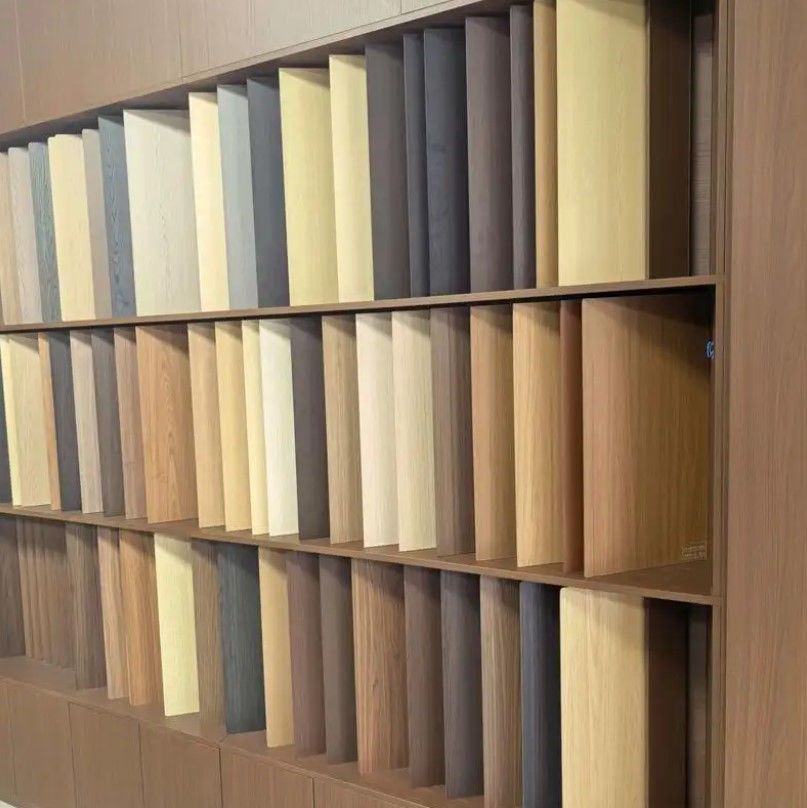
Raw particleboard has a relatively rough, porous surface that is unsuitable for direct use in finished furniture. The vast majority of particleboard sold for furniture and cabinetry applications is therefore finished with a surface treatment. Melamine-impregnated paper is by far the most widely used finish for furniture-grade particleboard. In the melamine laminating process, decorative paper printed with wood grain, solid colour, or abstract patterns is impregnated with melamine resin and bonded to the particleboard surface under heat and pressure. The result is an extremely hard, smooth, scratch-resistant surface with excellent resistance to household chemicals, heat, and moisture — all essential properties for kitchen and bathroom cabinetry.
Modern melamine particleboard is available in an almost limitless range of colours, textures, and patterns, from simple solid whites and greys to sophisticated wood grain reproductions that are nearly indistinguishable from natural veneer at normal viewing distances. Synchronous-texture melamine finishes, in which the surface emboss pattern is perfectly registered to the printed grain or pattern beneath, deliver a particularly realistic tactile and visual effect that has made them extremely popular in premium cabinetry applications. These advances in surface technology have dramatically elevated the aesthetic possibilities of particleboard-based furniture design.
Thickness Options and Applications
Particleboard for furniture use is manufactured in a wide range of thicknesses, from 8 mm for lightweight back panels and drawer bases to 25 mm or more for heavy-duty shelving and worktops. The most commonly specified thicknesses for cabinet carcasses are 16 mm and 18 mm, which provide an excellent combination of stiffness, screw-holding strength, and weight. Horizontal panels such as shelves and tops tend to be specified at 18 mm or thicker to resist sagging under load across longer spans. Doors are typically made from 18 mm board to provide the mass and rigidity needed for smooth, quiet operation of hinges and catches.
It is worth noting that particleboard's screw-holding performance is lower than that of solid timber or plywood, particularly at panel edges. This is a well-understood limitation that experienced furniture manufacturers address through careful joint design, the use of cam locks and other hardware designed for particleboard, and the use of dowels or biscuits to distribute stress across larger areas. When designed and assembled correctly, particleboard furniture can deliver decades of reliable service under normal household use conditions.
As the global furniture industry continues to evolve towards greater efficiency, lower waste, and more consistent quality, particleboard's central role in manufacturing is secure. Its compatibility with digital cutting technologies, automated edge banding, and robotic assembly systems makes it ideally suited to the highly automated production lines that characterise modern furniture manufacturing. For buyers seeking cost-effective, good-looking, and durable furniture substrates, melamine-surfaced particleboard from a quality manufacturer remains one of the most compelling options on the market today.